Choosing the next stage
Step Back, Hold, or Stop? Three Different Decisions
“Step back” is often used to describe every difficult moment, but it is not the same as holding the current stage or stopping for help. Clear decision language keeps one tense observation from becoming a rushed reunion, a full reset, or an unsafe experiment.
Hold when evidence is incomplete or mixed. Step Back one stage when the current exposure is too difficult but a simpler setup remains safe and manageable. Stop and seek help for injury, sudden health or behavior change, eating or elimination change, immediate danger, inability to separate, or escalating conflict.
Use the safety stop before ordinary stage logic
A stage decision is not appropriate for an injury or wound, a sudden unexplained health or behavior change, an eating or elimination change, immediate danger, or an inability to maintain secure separation. Pause direct contact and seek appropriate individualized guidance. The safety and escalation page explains the boundary; the self-check cannot diagnose or judge urgency.
If a fight is happening, do not put your hands between the cats. Use distance, a closed door, or a solid barrier only if you can do so safely, then contact the appropriate professional or emergency service.
Hold means “we need clearer evidence”
Hold keeps the same setup while you gather comparable observations. Use it when the behavior record is missing, when different sessions tell conflicting stories, or when the current exposure is not clearly easier or harder. Hold is not a reward and it is not a failure; it prevents a guess from becoming a new variable.
Record the same practical fields each time: distance or barrier, session length, strongest behavior, ability to turn away, eating or play when relevant, resource access, and recovery. A short consistent record is more useful than a long story that changes the conditions each time.
Step Back means “use one simpler stage”
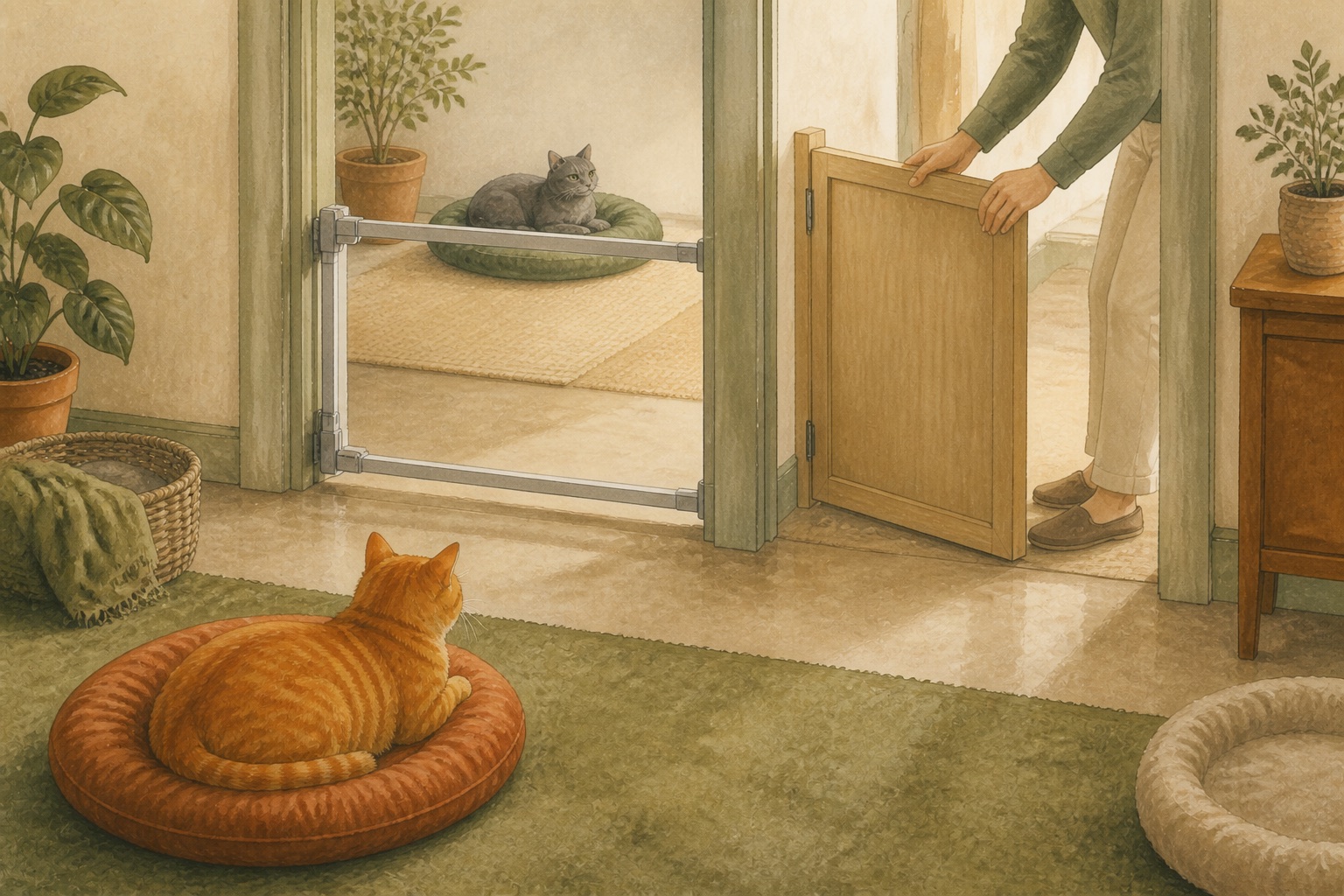
Step Back returns one stage when the current exposure produces a mild stress signal but both cats can still disengage and recover in a simpler arrangement. It might mean more distance, shorter exposure, an opaque barrier instead of visual contact, or scent-only work, depending on the household’s current stage. Choose the smallest change that restores safe observation.
Do not step back by adding punishment or by forcing a new test. Do not skip multiple stages unless individualized professional guidance says otherwise. The one-stage boundary keeps the plan explainable and reduces the number of variables you change at once.
Stop means “ordinary automation is not enough”
Stop and seek help when one cat cannot disengage, pursuit or physical conflict is escalating, essential resources cannot be accessed, safe separation is not possible, more than two cats are involved, or a health and safety flag appears. A stop decision is not a prediction about the relationship; it is a boundary on what this educational flow can responsibly cover.
The free educational self-check screens for those conditions before asking about stages. Its eligible result explains one next action and keeps payment closed during the research preview. The sample result shows what a Hold decision looks like when the safety gate is clear.
When a repeated Step Back needs another pair of eyes
Repeated regression, persistent resource blocking, escalating conflict, or a household that cannot supervise reliably is a reason to ask for individualized behavior guidance. A veterinarian can address health questions and referrals; a qualified feline behavior professional can help review the environment, routes, barriers, and pacing.
For professional context, see the 2024 AAFP Intercat Tension Guidelines. Cat Reintro Guide uses a conservative vocabulary—Advance, Hold, Step Back, Stop and seek help—without claiming a universal timetable.
Frequently asked questions
Should I Hold or Step Back after hissing?
Record what happened around the hissing. Hold when the evidence is incomplete or mixed. Step Back when the current exposure is clearly too difficult but both cats can disengage and a simpler stage is safely manageable. A safety flag means Stop.
How far should I step back?
Return one stage to the simplest setup that restores safe disengagement and independent access. Avoid universal timers, forced contact, or changing several variables at once.
Is stepping back a sign that the introduction failed?
No. Step Back is a conservative management decision that changes one stage when the current exposure is too difficult. It is different from a safety stop and does not predict the final relationship.