Reading progress
Progress Is More Than the Absence of a Fight
A quiet session can still contain blocking, freezing, hiding, or a cat losing access to a route. Progress is more useful when it can be observed repeatedly: both cats can disengage, normal activities remain possible, and the setup stays safe without forced proximity.
Look for repeatable observations rather than one “good” session. Both cats should be able to turn away, access essentials, and recover without pursuit. Hold when the evidence is mixed; move only one stage at a time; stop and seek help when a safety flag or unsafe household overrides the ordinary flow.
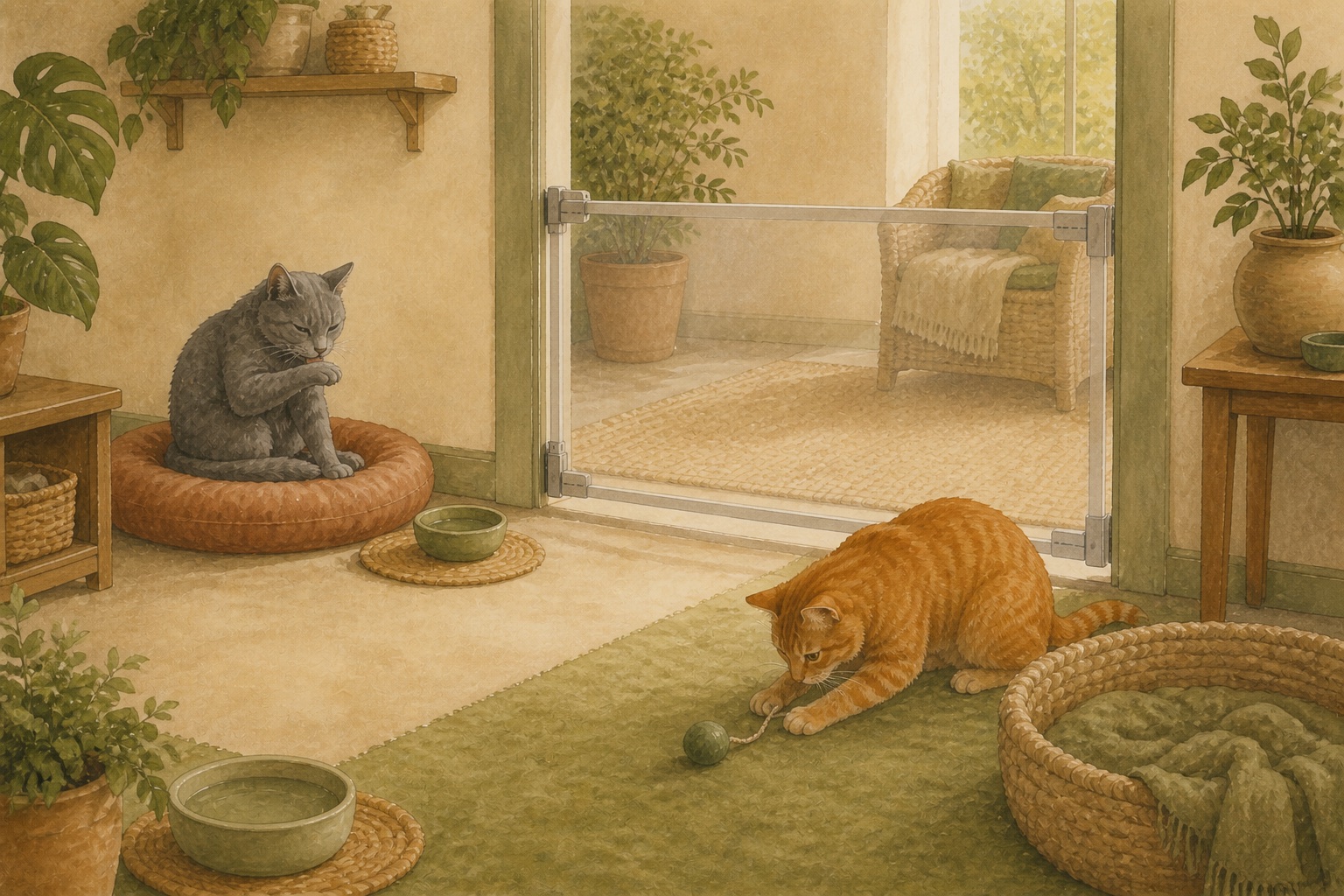
Safety comes before signs of progress
Progress language does not override a red flag. Pause direct contact for an injury or wound, a sudden unexplained health or behavior change, a change in eating or elimination, immediate danger, or inability to maintain secure separation. The safety guidance explains when the ordinary educational flow should stop and a veterinarian, healthcare professional, emergency service, or qualified behavior professional may be needed.
A quiet room is not proof that the cats are comfortable. Look for what each cat can do and what each cat cannot do, without assigning a hidden emotional cause.
Observable signals that make a stage easier to read
Useful observations include loose or neutral posture, ability to turn away, independent access to food and water, engagement with play or rest when appropriate, and recovery after the session. These are context signals, not a diagnostic score. A cat that remains silent but cannot leave, cannot reach a resource, or is watched continuously still needs a more conservative setup.
Write down the distance or barrier, exposure length, strongest behavior, whether each cat could disengage, and recovery time. Repeat the same setup before treating a pattern as evidence. The more variables change at once, the harder it becomes to know what the cats were responding to.
Why one good session is not a green light
A single calm observation can happen because the exposure was brief, the cats were tired, the route was different, or the moment simply did not test the difficult part of the setup. Use repeatability as a guardrail. When observations are missing, contradictory, or collected under different conditions, Hold is safer than guessing.
The educational pathway permits at most one stage of forward movement in a day. Do not use a good session to justify forced proximity, a longer exposure, or several changes at once. If you cannot tell whether the current stage is helping, repeat the current setup or ask for individualized help.
How the same evidence can support Hold or Step Back
Hold keeps the current setup while you gather clearer evidence. Step Back returns one stage when the current exposure produces a mild stress signal but both cats can still disengage and recover in a simpler setup. Stop and seek help is different: it applies when a safety rule or serious management limit overrides ordinary stage logic.
The free educational self-check turns these observations into one current stage, one blocker, and one next-24-hour action. Read the sample result to see why a cautious Hold can be a useful decision rather than a failure.
When progress is too difficult to judge alone
Ask for individualized guidance if progress repeatedly stalls, one cat controls essential routes, the setup cannot be supervised reliably, conflict intensifies, or more than two cats are involved. A professional can help compare the environment and observations without relying on a universal timetable.
For professional context on intercat tension, see the 2024 AAFP Intercat Tension Guidelines. Cat Reintro Guide describes observable progress but does not promise peaceful coexistence or a specific timeline.
Frequently asked questions
What is a good sign during cat introduction?
A useful sign is repeatable, observable ability for both cats to disengage, access essentials, and recover without pursuit. No single behavior proves readiness, and safety flags always take priority.
Can cats eat or play during an introduction?
Eating or play can be useful context when normal for that cat, but it is not a pass/fail test or a guarantee. Record the whole setup, including distance, disengagement, resource access, and recovery.
When should I advance to the next stage?
Advance only when repeated observations support a cautious change, both cats can disengage, and the household can keep the setup safe. Move no more than one stage in a day and Hold when evidence is mixed.