Resource access
Resource Blocking Can Be Quiet—and Still Matter
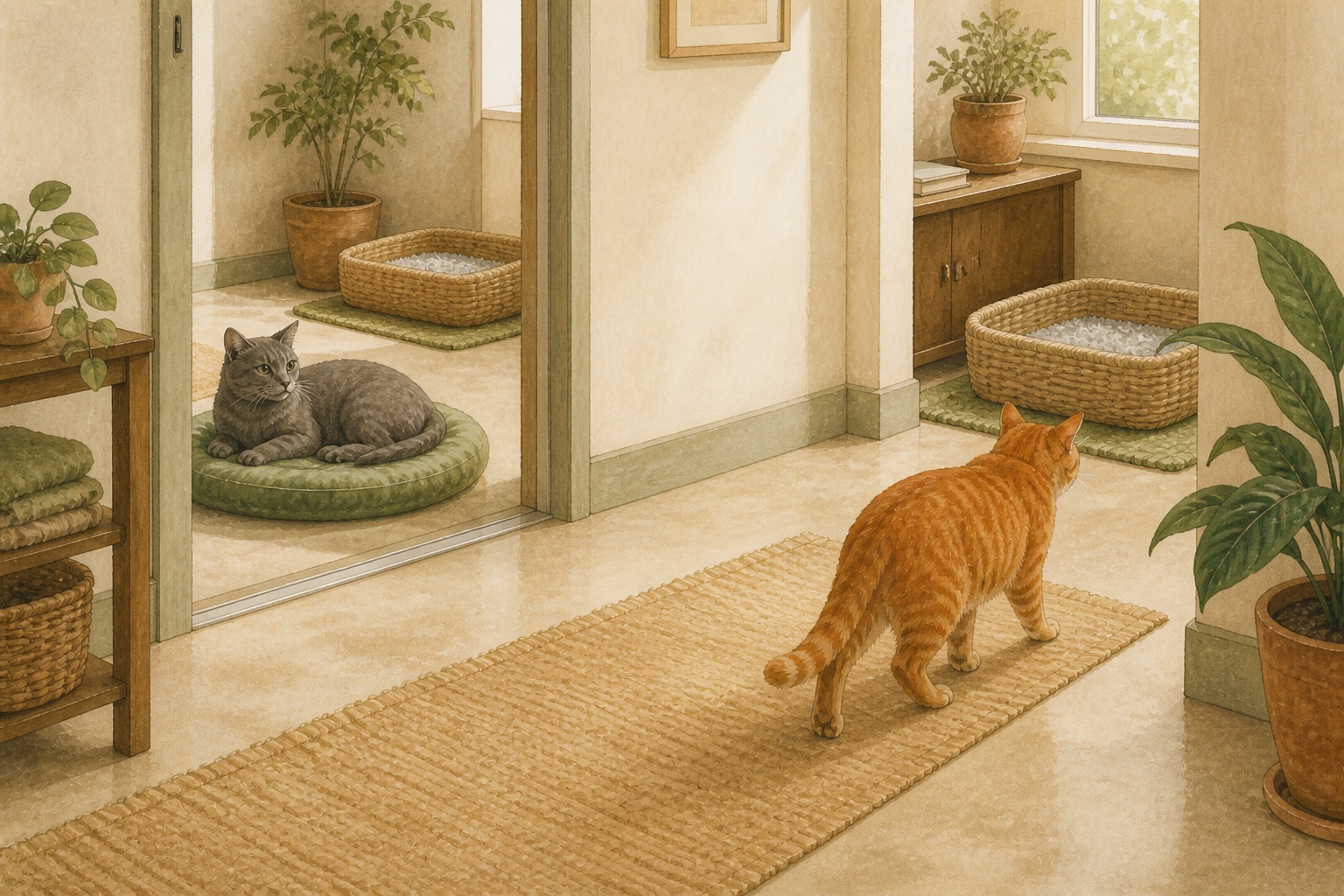
A cat does not need to chase another cat for access to become a problem. Waiting in a doorway, controlling a route, watching a litter area, or making another cat retreat can change what that cat can safely use. Start by observing access, not by guessing at a motive.
Map whether each cat can reach food, water, litter, resting and hiding places, and a safe route without passing through the other cat’s control. If access is unreliable, the cats cannot be safely separated, or eating or elimination changes, pause the automated flow and seek appropriate help.
Check the safety gate before mapping resources
Resource access becomes a veterinary or safety question when a cat stops eating normally, strains or repeatedly tries to urinate, passes little or no urine, has another concerning elimination change, or shows a sudden unexplained health or behavior change. An injury, immediate danger, or inability to keep the cats safely separated also overrides ordinary stage advice. Read the safety and escalation guidance before changing the setup.
A guide cannot decide whether a symptom is caused by a relationship problem. If you are unsure whether a cat is eating, drinking, urinating, or defecating normally, contact a veterinarian rather than using a reintroduction checklist as a substitute.
What blocking can look like
Blocking is an access pattern. One cat may stand in a doorway, wait near a litter area, follow another cat toward a resource, watch from a route, or make the other cat turn around. The affected cat may avoid a room, wait until the other cat leaves, use a less convenient location, or remain tense near a necessary resource. None of those observations proves a diagnosis or explains intent; they show that the household should examine access more carefully.
Observe from a safe distance and write down the resource, the route, the time, which cat approached, what happened next, and whether the cat could leave. Do not corner a cat to test the route, carry cats toward a resource, or punish a warning signal.
Build an access map before changing the stage
A useful map names each essential resource and the path to it. Look for doors, narrow corridors, stairs, furniture, and resting places that create a single unavoidable route. The immediate goal is not to optimize a universal number of bowls or litter boxes; it is to identify whether either cat depends on passing through the other cat’s space.
- List food, water, litter, resting, hiding, and exit routes for each cat.
- Mark places where one cat can wait while the other approaches or leaves.
- Check whether each cat can turn away and reach a safe area without being followed.
- Keep the environment predictable while you compare observations across sessions.
When access problems mean Hold, Step Back, or Stop
Hold when you have not observed the access pattern clearly or when different observations conflict. Step Back when the current exposure makes a mild resource-access problem more likely but a simpler, more separated setup remains safe to manage. Stop and seek individualized help when a cat cannot reliably access essentials, the cats cannot be separated, conflict is intensifying, or a health or emergency flag appears.
The free educational self-check asks about resource blocking and independent access after the red-flag questions. Its result is a conservative educational summary, not an instruction to ignore veterinary advice. The sample result shows how one blocker can be explained without assigning a motive.
When to ask for individualized help
Ask for help if the same cat repeatedly controls routes or essentials, if avoidance persists despite a safer setup, or if the household cannot supervise and separate reliably. A veterinarian can address health questions and referrals; a qualified feline behavior professional can review the layout, routines, and staged plan.
For professional context, see the 2024 AAFP Intercat Tension Guidelines. Cat Reintro Guide keeps its claim narrow: observe access, protect safety, and choose a conservative next step.
Frequently asked questions
How can I tell whether one cat is blocking the litter box?
Watch the route and the timing from a safe distance. Record whether one cat waits, follows, watches, or causes the other cat to turn away, and whether the affected cat can access another safe route. Do not force a test or use the guide to interpret an elimination symptom.
Is resource blocking always aggressive?
The guide does not diagnose aggression or intent. Resource blocking is an observable access problem that can matter even without a chase or fight. Focus on whether each cat can reliably reach essentials and leave safely.
Should I add more resources immediately?
First identify the route and safety issue, follow veterinary advice for any eating or elimination change, and avoid making several changes at once. A qualified professional can help design a household-specific setup.